Customer Succes stories
Royal Borgesius
Find out how Royal Borgesius is revolutionising bakery operations nationwide with AgileWalls, improving visibility and collaboration at every level.
Find out how Royal Borgesius is revolutionising bakery operations nationwide with AgileWalls, improving visibility and collaboration at every level.
Borgesius is one of the largest and oldest bakery companies in the Netherlands. Headquartered in Bunschoten, the company supplies various types of bread and dough to over 1,000 Albert Heijn shops and nearly 100 in Belgium from nine branches across the Netherlands. Philip Uythoven, Senior Manager of Continuous Improvement at Borgesius, is well aware of the importance of visual management and Obeya. He uses the walls of AgileWalls to make performance management tangible, visible and workable at different levels of the organization.
In recent years, Borgesius grew and became a strategic partner of Albert Heijn. With that increase in scale also came the call for professionalization. Since early 2024, Senior Manager Continuous Improvement Philip Uythoven, together with his colleagues from the Operations Management Team, has been working on that professionalization drive from Borgesius’ headquarters.
The core of his assignment: create a culture of continuous improvement at all levels in the organization.
For Uythoven, togetherness is at the heart of Lean work. “My motto is ‘see together, understand together, act together’. ‘Together’ is the key word here. You don’t work hierarchically top-down but, from shared ownership of the challenges and solutions, together on organizational goals. And of course with Key Performance Indicators (KPIs) and as much as possible based on measurable data.”
Central to the Performance Management approach at Borgesius are three key-moments:
In these meetings, the walls of AgileWalls are an important tool. Uythoven: “Day wall, Periodic wall and OMT wall are all arranged in the same way. This makes it immediately clear to anyone entering the room what the status is. That way, discussions are not about form but about content.”
The Day start meeting is a prime example of this, Uythoven says. He is regularly present as a spectator, a bit in the background, to see what happens. Every working day, those responsible for the Borgesius bakery’s performance, such as a production manager and a head of technical services, have a short stand-up. “They stand at a spot close to the shop floor near a large wall board measuring about 2 x 3 metres. White overcoats on, hairnet on their heads.”
Using the AgileWalls Day Board, they discuss the previous day’s performance, including deviations from KPIs and actions to be taken. “This involves very concrete things: how many loaves of each kind were baked, how many were rejected, any complaints about quality, machine downtime, the impact on costs, and so on.”
At the top left of the Day Board is Borgesius’ royal logo, above the columns are the four result areas: Safety, Quality, Delivery and Cost. In the boxes below are graphs and tables showing how performance compares to the agreed KPI standards. Occasionally, someone walks to the wall to place a concrete action item in a transparent frame on the board.
Uythoven: “That is the added value of this way of working. The conversation is important. During the stand-up, everyone sees the dashboard and contributes information and ideas. Moreover, a different manager is always the facilitator of the Day Meeting. That all adds to the collectivity and commitment.”
In the preliminary phase of the Lean implementation, a digital dashboard was also considered. In the end, the choice fell on a physical wall board from AgileWalls. Uythoven: “The advantage of a real board is that you don’t need a laptop, no network connection, no projection. Moreover, it is less distant. An action item that you manually place on a board yourself is still more ‘yours’ than an action item that someone else adjusts on a laptop.”
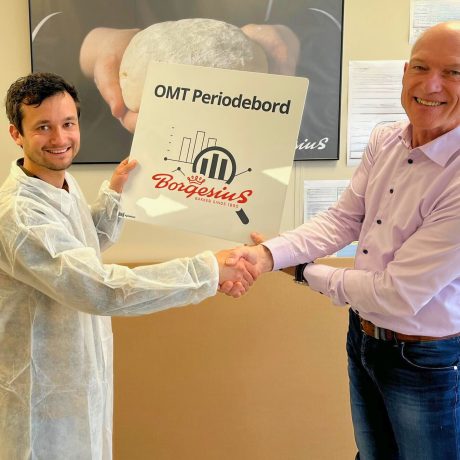
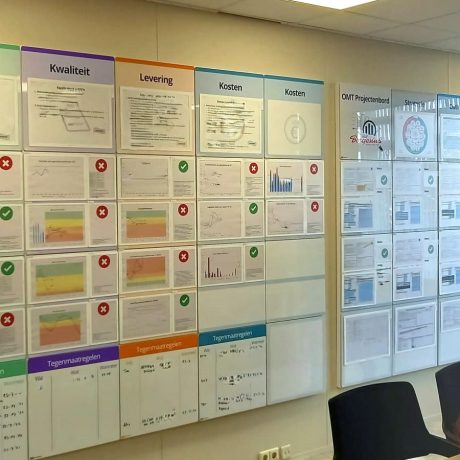
For Philip, it’s important that the information is always visible. “They are always there, not just during stand-ups. In the chemical company where I worked before, they used folding hinge boards, in another company there was a glass-only meeting room in the central hall. Everyone passed by there and saw the boards. AgileWalls does the same, in a clear and attractive way.”
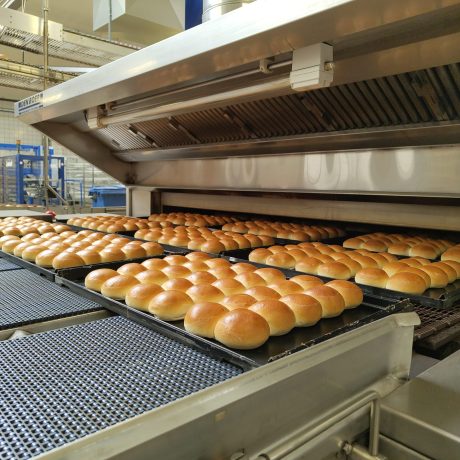
The first focus of Borgesius’ Continuous Improvement team is to reduce material loss during the production process or afterwards. “In a bakery, material is lost at four stages: before the oven, after the oven, through overweight and through so-called ‘overbread‘.”
Before the oven flour may fall from a bag or dough from a conveyor belt. A failure of a conveyor belt or the oven can also cause material loss. After the oven bread can be lost during slicing or packing, for example if a package tears. Uythoven: “These deviations are sometimes simple to solve with an aid, a different set-up at the machines or adapted instruction and training.”
From Overweight is when a bread contains more ingredients than the legal minimum under the Bread Act. “Weighing more than legally required means loss for the bakery. So we look for an optimum between what is minimally required and the accuracy our process can handle. We also monitor this by comparing the weight of inputs and outputs. Sometimes a root cause analysis is needed to find out the root cause.”
Overbread indicates overbaked bread. Uythoven: “We bake according to certain baking windows, time slots and order. We do this on a forecast from the AH shops. But during baking, the final orders for each shop come in, and they almost always deviate. An optimum is then sought between our bakeries and the various shops, but sometimes bread is left over. We call this over-bread. We try to solve this by optimising forecasts and also by baking in a smart order and testing whether that works.”
“People reacted enthusiastically to the AgileWalls prototype. One branch manager even immediately asked ‘When can I get a board like this?'”





 EN
EN  NL
NL